Tuesday, August 10, 2010
Journalist’s new book, planned movie examine UFO questions
By Steve Hammons
Two new examinations of the UFO situation may provide increased insight and understanding for much larger audiences.
Journalist Leslie Kean’s book UFOs: Generals, Pilots and Government Officials Go on the Record goes on sale Aug. 10, 2010, and is being praised as thorough and professional reporting on this mysterious topic.
The planned feature film Majic Men is based on the research and books of physicist Stanton Friedman and investigator Donald R. Schmitt. Producers Don Most and Bryce Zabel are helping lead this project.
Kean’s book and the Majic Men movie, along with an increasing number of responsible, intelligent and fascinating media explorations of the UFO subject, are sure to improve public awareness and expand our perception of the possibilities involved.
By doing so, our readiness and preparedness to deal with certain possible or probable situations of this kind will be enhanced.
CREDIBLE JOURNALISM
Kean has worked as a journalist for major newspapers and has a rich background in investigative journalism. She has had a longstanding interest in the UFO phenomena, having conducted in-depth research on the subject for a decade or more.
As the book title indicates, she focused on interviews with high-level government officials from the U.S. and other countries as well as the American and international aviation community, military and civilian.
She provides more solid facts that further inform us about something real that is going on regarding UFOs.
The apparent secrecy and security surrounding this mysterious topic presented significant challenges even for an experienced investigative journalist like Kean. Human development, scientific advancement, international relations, national security or even planetary security are reported to be possible elements of this puzzling situation.
Her book description notes that, “Throughout, she presents irrefutable evidence that unknown flying objects – metallic, luminous, and seemingly able to maneuver in ways that defy the laws of physics – actually exist.”
Kean’s book has received praise from scientists, scholars, journalists and others.
Well-known physicist and TV science host Michio Kaku, Ph.D., wrote, "At last, a serious and thoughtful book about this controversial subject. Skeptics and true believers will find a treasure trove of insightful and eye opening information. This book is bound to set the gold standard for UFO research."
Another respected physicist, Harold E. “Hal” Puthoff, Ph.D., said, “In these pages we are confronted head-on by the UFO phenomenon as revealed firsthand by highly credible government officials and military aviation experts. Their credibility and integrity cannot be questioned, and their firsthand observations cannot be ignored.”
He also added, “Leslie Kean provides a challenging analysis and she writes with penetrating depth and insight. The revelations in this book constitute a watershed event in lifting the taboo against rational discourse about this controversial subject.” Puthoff is director of The Institute for Advanced Studies at Austin.
John L. Petersen, founder and president of The Arlington Institute also pointed out that, “In an area of study where there aren’t many, this is a serious book. It is credible, clear, and compelling, without any farfetched jumps in logic and assumption. Leslie Kean not only makes the case for, but calls for, a whole new concrete and realistic perspective on UFOs that has more honesty and integrity than any other that I have read. This is a book for anyone with an open mind.”
Christopher C. “Kit” Green, MD, Ph.D., of Harper University Hospital and Ohio’s Wayne State University School of Medicine, also gave the book a thumbs-up. "Leslie Kean’s astonishing book is the finest piece of investigative journalism ever written on this subject. She has an incomparable ability to ‘give voice’ to a constituency of exceptionally qualified and unbiased first-hand observers. They are not from the fringe, not groupies, and not delusional.”
Green noted, “Rather, they are high-level military, intelligence, aerospace, and government officials who speak with authority while providing reports that document actual, physical craft. Kean’s book represents the first important step toward a new U.S. government openness about UFOs. It brings forward a reality otherwise buried for far too long inside official mystery, and elevates the discourse above that of small-minded public discussions."
MOVIE ON INVESTIGATIONS, INVESTIGATORS
The Majic Men film project is based on the lives of Stanton Friedman and Donald R. Schmitt and their years of research into the so-called Roswell incident and circumstances involved in UFOs.
Schmitt and co-author Thomas J. Carey wrote the book Witness to Roswell, released in 2007 with an update in 2009. Friedman’s book Top Secret/MAJIC was published in 1997 and updated in 2005.
The titles of the book and movie reference an alleged secret group formed by U.S. President Harry Truman following the Roswell incident. The group is rumored to have been called Majestic, Majestic-12, MJ-12, Majestic Agency for Joint Intelligence or, simply MAJIC. There have also been indications of a security clearance level called MAJIC.
Stellar Productions, a southern California production company, has acquired rights to the stories of Friedman’s and Schmitt’s investigations.
According to a July 2, 2010 press release, Bryce Zabel, president and writer/producer at Stellar said, "Our film is about two down-to-Earth guys who are chasing a story that is literally out-of-this-world. Both Friedman and Schmitt are underdog American heroes, men who hate being lied to and will bear almost any burden to get at the truth."
The press release also explains that the film will focus on lives of Schmitt and Friedman “as they continue investigations from the late 1970s to our near-present day, revealing how the original UFO secret was handled. What they discover is an intense five-year-period from the Roswell crash of 1947 through the briefing of President Dwight Eisenhower in 1952.”
“The screenplay for Majic Men will be written by Zabel, winner of the 2008 Writers Guild of America award for the Hallmark miniseries, Pandemic,” according to the press release. “He has written feature film scripts for Warner Bros., Universal, Fox, Disney, and New Line.”
“His work in the UFO field includes creating the NBC drama series, Dark Skies (scheduled for DVD release in January 2011), writing and producing the Sci-Fi Channel original film Official Denial, and working on the development team of the Spielberg series, Taken.”
The press release also noted, “The production team's Don Most, although best-known for his work on the popular sitcom Happy Days, is also a long-time activist in the movement to end UFO secrecy. He recently produced and directed two feature films, Last Best Sunday and Moola.”
Most said, "Majic Men is as much about the investigators as it is the investigation. Audiences are going to find both their hearts and their minds opened when they watch it."
“Stellar Productions may partner with another production company or studio to develop the Majic Men project. Additionally, a new non-fiction book, also titled Majic Men, is expected to coincide with the release of any future film,” according to the press release.
For more information, visit the website of Kean’s book and the Majic Men website.

Saturday, May 29, 2010
Public readiness officer: Unusual phenomena, edge science are complex
By Steve Hammons
Amid the research into alleged UFOs, extraterrestrial visitation, unusual intelligences, weird physics, expanded human consciousness, other dimensions and similar kinds of edge-science topics, there is also the element of public acclimation or public preparedness.
Some researchers have indicated that certain individuals and groups may have been working for several decades to gradually get us ready to face some of these interesting and surprising developments.
The public acclimation agents and activities might have discreetly worked with moviemakers, writers, journalists, others in the media as well as those researchers looking into unconventional science subjects.
At least that is one line of thought.
Are certain areas of our defense, intelligence, scientific, media and other communities involved in this?
If so, what might such a public readiness officer say to us?
BIGGER PICTURE
He or she might tell us that there are several areas of discovery that are complex and sensitive. These developments could change the way we look at ourselves, life, the Earth and the Universe.
We might be told that gradual and safe public education and orientation about discoveries in human consciousness – such as those of Project STAR GATE – will benefit the human race.
Even though Project STAR GATE was top secret for many years, information about it is now widely available and awareness about the implications is steadily growing.
A public acclimation advisor could explain that enhanced human perception might be helpful in dealing with extraterrestrial and/or extra-dimensional visitors, as well as other intelligences that may be around us, but are hidden or semi-hidden.
Some of these intelligences could be angels or unusual creatures of some kind that can move in and out of different dimensions that exist in a multi-verse around us and within us. They can move through the mysterious veils, boundaries or portals, and can be both seen and unseen, our readiness officer might tell us.
And, we might be cautioned that, though many intelligences and forces are good, some may be problematic or even dangerous. Some might also simply be wild and free creatures that are unpredictable.
In short, there are several kinds of emerging developments that may or may not be connected in clear ways. Our readiness agent might explain that all the answers and all the puzzle pieces are not fully understood, though they and we are trying to gather more information and get a better understanding of the bigger picture.
That bigger picture could include a much larger and more comprehensive intelligence, force or plan. And the coincidences and synchronicities we sometimes experience can have meaning that we don’t understand at the time, according to the hypothetical preparedness advisor.
There are many mysteries. And even though we try to understand them to the best of our ability, maybe it is supposed to remain an ongoing mystery. Maybe it is supposed to be that way, we might be told.
PARADIGM SHIFT
The American and international public will continue on their learning curve about these leading-edge subjects, the officer tells us.
Educational institutions, media platforms, scientific activities, governmental groups and average people will continue on a path of greater understanding and will apply this understanding in positive ways. However, there could be some challenging elements as well, according to the readiness advisor.
Eventually, there will most likely be a tipping point or paradigm shift when we experience a more comprehensive changed awareness. Then, things will become a bit more clear, the officer says.
Our acclimation agent might hint to us that the picture might become a lot more clear and something quite interesting and positive could occur.
But what? We aren’t quite sure, the acclimation advisor tells us. It’s somewhat out of our hands. We just have to do our best and be prepared. There are larger forces at work.
Our research, intelligence and reconnaissance have picked up a lot of information and indications. But, it’s difficult to identify the exact path that emerging developments might take, the advisor tells us.
We can just do what we can do, and try to improve our understanding and make the best choices we know how to make. We public acclimation officers can’t hold your hand – each human being, family, organization, community, tribe and nation must take responsibility to open their minds, learn, develop, be honorable and compassionate, do the right things and move forward.
The preparedness officer might ask us if we have any further questions. Only about a million.
Wednesday, May 19, 2010
Journalism’s dilemma: Covering weird science
By Steve Hammons
Today’s journalists, whether they are working in print media, TV or online platforms, face new challenges and opportunities.
As part of these developments, a large and growing public awareness about forward-leaning research and discovery may be changing the views of some professional journalists.
More and more people around the world are realizing that some of the most important issues of the day are emerging developments that may not have been adequately covered by both mainstream and alternative journalism.
Some of these science-related developments may have been considered too unconventional or were simply below the radar of many journalists. These kinds of topics include, for example, fascinating research about human consciousness and mysterious aspects of quantum physics.
Editors and publishers may often want to avoid some of the more unconventional topics, preferring the standard coverage of current events that are somewhat more tangible and accepted.
However, many journalists are willing to take a look at certain edge-science issues – as well as the profession of journalism in relation to them.
SCIENTIFIC REVOLUTIONS
A May 17, 2010, “editor’s blog” by Christian Science Monitor editor John Yemma was titled “Skeptical about skepticism.” Yemma pointed out that “a true skeptic questions even conventional wisdom.”
“Journalists are professional doubters,” Yemma wrote.
Whether the topic is unusual phenomena of various kinds or more conventional subjects, Yemma pointed out that excessive negativity can be a form of denial about unusual or uncomfortable possible truths.
He noted, “And that’s where we have a problem in rational discourse today. Writing in a recent issue of the 'Chronicle of Higher Education,' Carlin Romano made a distinction between today’s ‘science warriors’ and the real ‘philosophers of science.’”
“The former take an absolutist approach to science, skewering everything from the Loch Ness monster to conventional religious beliefs as ignorance,” according to Yemma.
“Philosophers of science, however, understand science to be a set of beliefs and knowledge that at times can be turned on its head, a recurring process that Thomas Kuhn described in his book 'The Structure of Scientific Revolutions,’” Yemma said.
CHANGED CLIMATE
In recent decades, certain science-related subjects have not received the mass-media journalistic attention that we can sometimes see emerging today.
There may have been legitimate reasons why certain topics remained off-limits for mainstream journalism. So, past journalists can perhaps be excused from their failure to adequately cover these subjects.
But that was then.
Today, the climate seems to have changed – and is continually changing. Now, it might be important to inform the public about interesting, if unconventional, research and discovery that are the focus of much interest around the world.
It seems that maybe it is time for journalism to shift gears and take a vigorous and reasonable look at the fascinating discoveries being made about a wide range of "weird science" subjects.
If journalists do not do this, they risk losing more credibility and being left behind by not only the public, but also by the facts on the ground in a changing reality.
Saturday, May 15, 2010
UFOs, extraterrestrials invade 1800s Arizona in new movie ‘Cowboys and Aliens’
By Steve Hammons
While the people of a small Arizona Territory town in 1873 are busy battling regional Apaches, hostile extraterrestrials attack and unite the warring humans in the movie project "Cowboys and Aliens."
Will the foreign invaders try to push the humans off their land using advanced technology and weapons? Do the extraterrestrials regard the Earthlings as primitive savages?
Maybe the humans have a higher consciousness and are better prepared to fight this unconventional conflict than the aliens expect.
Harrison Ford, Daniel Craig and Olivia Wilde are among the cast members who will push back against the hostile ETs.
Universal Pictures, DreamWorks and Imagine Entertainment will reportedly begin shooting in Arizona’s neighboring New Mexico in June or July and casting calls for extras have already been announced. "Cowboys and Aliens" is planned for release in summer 2011.
Steven Spielberg and Ron Howard are two of the many moviemaking and creative development pros involved. Jon Favreau will direct.
Other members of the writing and creative team include Damon Lindelof, Mark Fergus, Alex Kurtzman, Robert Orci, Hawk Ostby, Brian Grazer, Alex Kurtzman Scott Mitchell Rosenberg, Bobby Cohen and Denis L. Stewart.
INVASION OF AMERICA
Discussions about the possibility of visitation to Earth by extraterrestrials or other unusual intelligences, including the story in "Cowboys and Aliens," often note the impacts on Native American Indian tribes when Europeans landed in “The New World.”
Using high-technology weapons and what we might now call psychological warfare, Europeans dominated Indian tribes militarily and obtained nearly all of the lands the indigenous people had lived on.
Biological warfare also played a part, both intentionally and inadvertently, as Indians were wiped out by European diseases.
Some tribes, notably the Cherokee in the 1700s Appalachian Mountain region, intermarried with English, Scottish and other Europeans to a degree, and assimilated into the new dominant culture.
Still, their lands were taken from them and their way of life was changed forever.
A century later in the mid-1800s southwest, where "Cowboys and Aliens" takes place, a similar story played out as Apaches, Navajos, Utes and many other tribes were militarily defeated and the lands they lived on taken by the waves of strange invaders.
Today, Arizona and New Mexico are both home to large Native American Indian populations descended from ancient people who lived in the region for many thousands of years. Some of these tribes also have longstanding legends of star people and intelligent beings who are not humans.
These tales are not only historical accounts. There are also current and ongoing reports of anomalous beings, UFOs and other mysterious situations on Indian lands, including in Arizona and New Mexico.
STORY OF CURRENT SITUATION
These alleged incidents and experiences are in many ways consistent with continued indications about the possibility that Earth is currently being visited by extraterrestrial and/or some other kinds of intelligent beings.
Tales of the 1947 crash of a spacecraft near Roswell, New Mexico, still fascinate the public. These kinds of stories also form a basis for other claims that the U.S. government, military and intelligence services have been dealing with such a situation ever since.
In fact, Spielberg’s "Close Encounters of the Third Kind" (1977) is rumored to be partially based on a real-life U.S. operation referred to as Project SERPO that sent a team of U.S. personnel with friendly aliens to their home planet aboard their spacecraft.
A claim that human-looking extraterrestrials are among us was also the theme of a recent story about the alleged Operation TANGO-SIERRA, a U.S. intelligence effort that investigated and captured such an ET.
Also in recent weeks, a new emphasis on these kinds of issues emerged in the mainstream media as prominent scientists openly discussed possible impacts of human contact with extraterrestrial or anomalous life forms.
"Cowboys and Aliens" might also help us think about the many elements of such a scenario, not only in the present day or even in the 1800s, but also in the more distant history of American Indians and the human race as a whole.
In the movie, the townspeople and Apaches work together, adapt their minds to a rapidly-changing reality and develop new methods to deal with it.
This sounds a lot like “transcendent warfare,” a term used by a Navy SEAL officer in a research paper about the U.S. government activities involving human consciousness and perception known as Project STAR GATE.
"Cowboys and Aliens" has the potential to take audiences to an exciting exploration about these many elements of human and American history, accounts of real extraterrestrial contact with Earth and how we might deal with different types of strange visitors who could be friendly, hostile or some mix of both.
Wednesday, May 12, 2010
Intelligence officials may have unique approaches for UFOs, ETs
By Steve Hammons
If extraterrestrial and/or extra-dimensional beings or other intelligences are visiting Earth as some researchers suspect, are we approaching the situation in the best way?
This discussion has been in the news recently due to the comments of physicists Stephen Hawking and Paul Davies as well as other emerging developments.
As reported in the book "Hunt for the Skinwalker" by scientist Colm Kelleher, PhD, and journalist George Knapp, researcher Jacques Vallee recounts a situation in his own book "Messengers of Deception" that describes his interaction with a person he calls “Major Murphy.”
Vallee wrote, “Then he posed a question that, obvious as it seems, had not really occurred to me: ‘What makes you think UFOs are a scientific problem?’”
Vallee said to Murphy, “The UFO phenomenon could be controlled by alien beings.”
To this, Murphy responded, “If it is, then the study of it doesn’t belong in science. It belongs in intelligence.”
“Meaning counterespionage,” Vallee noted. “And that, he [Murphy] pointed out, was his domain.”
Murphy told Vallee, “In the field of counterespionage, the rules are completely different.”
Murphy advised Vallee “ ... you should look for the irrational, the bizarre, the elements that do not fit ... Have you ever felt you were getting close to something that didn’t seem to fit any rational pattern, yet gave you the strong impression that it was significant?”
TRANSCENDENT INTELLIGENCE
Does Vallee’s mysterious source Major Murphy have a point? Is the conventional scientific approach used by humans in our current stage of understanding the only or best way to deal with the question of possible anomalous visitation to Earth and contact with humans?
We might consider the same question when pondering other interesting phenomena. What about life after death and the alleged dimension we call the afterlife? How about extrasensory perception (ESP) of various kinds?
There may be several complementary paths that can be used to explore these and other fascinating topics. The conventional scientific approach has an important role. First-hand experiences and intuitive perception about certain phenomena might also be helpful.
And, as Major Murphy told Vallee, the intelligence and counterintelligence concepts and methods might also be valuable and useful. The integration of these different ways of perceiving current situations might lead to a synergy of transcendent perspective and understanding.
Maybe this is part of what has been termed “transcendent warfare.” The phrase was used by a Navy SEAL officer for a research paper about the U.S. defense and intelligence program on advanced human perception, Project STAR GATE.
The follow-on concept of “transcendent power” is meant to be one that is complementary to and synergistic with the military, diplomatic and persuasive elements called “hard power,” “soft power” and “smart power.” Major Murphy might have even been referring to something we could call “transcendent intelligence and counterintelligence.”
ADVANCED UNCONVENTIONAL OSINT
Just as average people from many walks of life try to become familiar with scientific developments, current events and contemporary issues of various kinds, our exposure to intelligence concepts might also be helpful.
In fact, “open source intelligence (OSINT)” is simply the information out there in the media, the Web, books, movies, TV shows and elsewhere that we can access and interpret. In this sense, all people can become agents of transcendent intelligence. This perspective about the grassroots awareness and empowerment of average human beings might also create increased synergy that can contribute to progress in many areas of human development.
When it comes to normal current events as well as unconventional topics such as UFOs, ETs, ESP, life after death and angels, a higher intelligence and many other mysteries of Nature and the Universe, we probably all have potential access to greater understanding.
We might even consider that OSINT, though it typically refers to gathering open information from conventional sources, might also have leading-edge aspects related to unusual or alternative acquisition of knowledge and understanding.
That is, greater perception by average people at the grassroots can include normal information gathering and more forward-leaning methods, such as intuition and advanced perception that have been identified by U.S. intelligence and defense programs such as Project STAR GATE.
By exploring these kinds of transcendent intelligence, it is possible that we can learn more about the many mysteries that seem to hold the potential for important discoveries.
Thursday, May 6, 2010
Understanding emerges about extraterrestrials, consciousness, mysteries
By Steve Hammons
Researchers, journalists and others seem to be re-evaluating reports about unconventional U.S. defense and intelligence activities regarding contact and interaction with extraterrestrial life.
The “situation awareness” about possible visitation to Earth by extraterrestrials, as well as other emerging scientific understanding about many phenomena, appears to be steadily improving. The nature of time and space, advanced research in human consciousness and the nature of apparent mysterious intelligences in the Universe or “multi-verse” are just a few of the key areas in leading-edge and forward-leaning investigations.
There are specific areas of interest and study as well as broad themes and indications that probably are worth paying significant attention to.
There are misconceptions as well as misinformation about some anomalous and mysterious phenomena. And, there are many areas of importance that we just don’t fully understand, according to some researchers.
RESEARCH, EDUCATION AND COMMUNICATION
To address, respond to and enhance increasing interest in various kinds of edge-science developments, new education, communication and information platforms are coming forward.
For example, Open Minds Production in Tempe, Arizona, provides online news, radio, TV and related resources about certain unconventional areas of study. Their Open Minds magazine also explores extraterrestrial contacts, UFO research and other fascinating topics.
Interestingly, Tempe is also home to Arizona State University’s Beyond Center for Fundamental Research, led by Dr. Paul Davies, author of the book The Eerie Silence: Renewing Our Search for Extraterrestrial Intelligence. The Beyond Center, staffed by ASU professors from diverse fields, is investigating and discussing a wide and deep range of emerging scientific knowledge.
The new magazine EdgeScience, associated with the Society for Scientific Exploration, recently published its third edition. This publication also looks at forward-leaning views and research in a variety of scientific fields.
And, information continues to surface about the U.S. defense and intelligence communities’ research into human consciousness, extrasensory perception and remote viewing. Usually referred to by the final code name known to the public, Project STAR GATE, these research and operational intelligence activities provided tremendous new understanding about the potential of human perception and awareness.
Through these and other efforts, there appears to be increasing awareness that there is much to be learned and understood about unknowns and mysteries in Nature around us and within us.
SECRET GOVERNMENT PROGRAMS
The recent attention paid to an account of the alleged U.S. investigation, apprehension, interrogation and “deportation” of a human-looking extraterrestrial reflects changing perspectives on such possible situations.
Referred to as “Operation TANGO-SIERRA” in recent online accounts, in 1980 U.S. defense and intelligence agents reportedly intervened in the ongoing contact between the extraterrestrial and a federal employee that had begun in 1977.
The initial source for this report is allegedly one of a handful of current and former Defense Intelligence Agency (DIA) officials who for the last several years have been releasing information about U.S. government activities involving extraterrestrial contact.
The DIA source put a researcher and educator, Victor Martinez, in touch with another source from an unnamed government agency. Martinez then passed the report on via e-mail to a large list of researchers, current and former government officials, and others. These same current or former DIA officials had reportedly followed similar procedures leading up to the release of information in late 2005 about an exchange program between the U.S. and a friendly extraterrestrial race of beings.
The program, which reportedly began in the early 1960s, sent 12 carefully selected and trained U.S. military personnel to the home planet of these extraterrestrials for a planned ten-year stay. The effort, referred to in the releases as “Project SERPO,” may have been the basis for part of Steven Spielberg’s 1977 movie Close Encounters of the Third Kind.
Are reports about Operation TANGO-SIERRA and Project SERPO true? Are they partially accurate mixed with inaccurate information? Are they completely untrue? It is possible that there are truths “between the lines,” though the details might be altered or even untrue.
The broad concepts about UFOs, extraterrestrial visitation and U.S. government engagement in the situation may, though, be truthful. What general messages can be taken from these two accounts?
It seems that some of the main themes are: ETs and possibly other anomalous intelligences are here on Earth, certain U.S. government elements have been actively involved for quite a while and the situation is complex, sensitive and challenging.
In addition, the wider public may have a “need to know” through a gradual, safe and steady process of information, communication, education and acclimation.
For more information, visit Open Minds Production at OpenMinds.tv, the Arizona State University Beyond Center and EdgeScience magazine on the Web site of the Society for Scientific Exploration.
Saturday, March 27, 2010
Can troops find hidden bombs with sixth sense?
By Steve Hammons
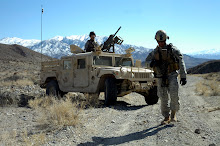
Recent research has determined that some US military personnel are better than others in the ability to detect hidden improvised explosive devices (IEDs). But why?
According to a US Army research project, troops raised in rural and forested areas seemed to be better at it. Troops who grew up in tough urban areas also seem to excel in this kind of perception.
The common denominator is “situational awareness (SA)” that is key to hunting and being aware in the natural environment as well as in dangerous neighborhoods where people can become a victim of violence or other crime.
But what other important factors might be in play? And how might the understanding of human perception and consciousness benefit all of us?
In the first issue of the fascinating new magazine EdgeScience (October 2009 edition), editor Patrick Huyghe’s article “Straight from the Gut” explored the two-year Army study on perception led by researcher and psychologist Steven Burnett. Huyghe also took a look at some of the media coverage on the study.
In addition, he notes the work of other well-known researchers on human consciousness who propose that other interesting elements may affect troops’ abilities to perceive IEDs.
These theories, backed up by significant research, note that hunches, intuition and gut feelings might be linked to the acquisition of information through human consciousness in ways we do not fully understand.
The conscious perception that something is going on that we need to be aware of might be related to factors other than clues in the physical environment that troops and all of us process consciously and unconsciously.
In some cases, another kind of perception may kick in. These may be split-second premonitions or what has been called “presentiment.” Troops and all humans (and maybe many animals) can use perceptual abilities and resources that have sometimes been called “anomalous cognition” of various types.
The recognition of danger, linked directly to personal and group survival, is a fundamental priority of human consciousness. As part of this perceptual priority, do we have a “sixth sense” that supplements and assists our other five senses of sight, hearing, smell, touch and taste?
MEDIA COVERAGE
In Huyghe’s EdgeScience magazine piece, he examined the New York Times article on the Army study by Benedict Carey who Huyghe described as an "experienced science writer hired by the Times in 2004 to cover human behavior and psychology.” The headline of Carey’s July 27, 2009, article was “In Battle, Hunches Prove to be Valuable.”
In Carey’s article, he notes, “The United States military has spent billions on hardware, like signal jamming technology, to detect and destroy” IEDs. He also explains that IEDs “have proved to be the greatest threat in Iraq and now in Afghanistan.”
“Still, high-tech gear, while helping to reduce casualties, remains a mere supplement to the most sensitive detection system of all – the human brain. Troops on the ground, using only their senses and experience, are responsible for foiling many IED attacks,” Carey wrote.
Carey also pointed out, “Everyone has hunches – about friends’ motives, about the stock market, about when to fold a hand of poker and when to hold it. But United States troops are now at the center of a large effort to understand how it is that in a life-or-death situation, some people’s brains can sense danger and act on it well before others do.”
Another article, this one in the Los Angeles Times, also examined the Army study. “Some troops have a sixth sense for bombs” was written by Tony Perry and published Oct. 28, 2009.
Reporting from the US Marine Corps base at Twentynine Palms, Calif., Perry wrote, “Military researchers have found that two groups of personnel are particularly good at spotting anomalies: those with hunting backgrounds, who traipsed through the woods as youths looking to bag a deer or turkey; and those who grew up in tough urban neighborhoods, where it is often important to know what gang controls which block.”
Perry added, “Of the bombs spotted before they could kill or maim, an estimated 90% were detected by someone, for instance, sensing something amiss along a dusty roadside in the southern Afghan province of Helmand or a crowded street in the western Iraqi city of Fallouja.”
Both articles by Carey and Perry examined the Army research project in some depth, interviewed researchers and troops, and explored theories of training to perceive threats and possible psychological aspects of this perception.
But, did either article (or the Army researchers) “take the next step” as EdgeScience magazine editor Huyghe called it?
Huyghe pointed out in his article that extensive studies “show that the brain actually anticipates emotionally charged situations, not only before the person is aware of them, but before any hint of them is available in any way, shape, or form.”
In other words, there are significant experimental and experiential indications that we have the capability to perceive things before they happen in linear time.
This view is consistent with research from the US joint military and intelligence project of the 1970s, ‘80s and early ‘90s generally referred to as Project STAR GATE. This project documented and used aspects of human perception and human consciousness that did “take the next step.”
A subsequent 2001 research paper by a Navy SEAL officer, prepared as part of his studies at the Marine Corps War College, proposed that implications from Project STAR GATE seem to demonstrate the advantages of learning more about human perceptual abilities.
In addition, he suggested that incorporating this kind of emerging understanding can be a key part of what he called “transcendent warfare.”
Project STAR GATE research and operational activities involved what some might call extrasensory perception (ESP). The project involved strict protocols trying to make use of this kind of perception. These formal procedures and methods were key parts of what was eventually called “remote viewing.”
Science journalists could focus more on these developments. In fact, journalists covering many kinds of beats may find important elements related to their work.
SITUATION AWARENESS
Interestingly, in the second edition of EdgeScience magazine (January-March 2010), a letter to the editor was published that provided more useful information on these subjects.
EdgeScience reader John MacLean explained that as a college instructor in Utah, he teaches a class in the “Technology Management Program” called “Reliability Engineering and Safety.” MacLean noted, “One of the chapters in this course is situational awareness.”
MacLean provided a short definition of situation awareness (SA): knowing what is going on around you.
In addition to MacLean’s succinct definition, SA has also been described as the perception of environmental factors within time and space, understanding the meaning of the factors and anticipating possible outcomes in the near future.
SA has become an important area in military activities, aviation safety, emergency services, critical engineering operations and similar fields.
“In this class we discuss how to have situational awareness and how to recognize when you have lost it. There are 11 clues that can be observed in one’s operating vocations that tell you that you are losing your situational awareness,” Maclean explained.
He points out in his letter to the editor that the 11 clues to the loss of situational awareness are primarily involved with conventional awareness of instrumentation, communication, adherence to standard procedures and similar aspects.
However, he notes that one of the clues involves “confusion, apprehensive feeling or gut feeling that something is wrong."
MacLean wrote, “Many dismiss various explanations as the subconscious observing a bad developing situation or seeing several of the clues by the subconscious. Personally, although some of these other explanations may be valid, I am wondering if precognition may be operable in these situations that are generally life threatening.”
MacLean goes on to explain how this “gut feeling” clue appears to have been demonstrated. He wrote, “An incident several years ago occurred with a Flying Tigers Airlines 747 on approach to Kuala Lumpur in Indonesia in the middle of a very dark night. From the direction they were on approach, the Instrument Landing System was out of service and they would have had to go another hundred miles to come in from the other direction where it was in service.”
“While several of the clues to losing awareness were eventually present, the first officer tried to get the captain to do the fly around, saying on three occasions, ‘Captain, I really don’t feel good about this, let’s go around and use the instrument system.’ These protestations occurred before any of the other clues were observable,” MacLean said.
“Because of the ultimate presence of several of the clues, unrecognized, they flew into a mountain. The other four clues were observable only just prior to the crash. From the data I observed in this incident, it appears the first officer’s comments were begun at least 15-20 minutes prior to the other four clues being observable.”
MacLean concludes his letter with a thank you to EdgeScience editor Huyghe. “The info you supplied in your article ('Straight From the Gut,' EdgeScience No.1) will be valuable in my class when we discuss situational awareness. I can’t put my finger on it precisely, but I have a feeling the ideas on precognition may be interacting somehow in the other 10 clues. Something to continue to ponder. Great article.”
NEUROBIOLOGY AND QUANTUM PHYSICS
From SA training to premonitions, ESP and remote viewing, we see a growing body of research and knowledge about human perception and human consciousness.
New studies in neurobiology are looking more closely at how the human mind and body might be processing information from our environment that we have no conscious knowledge of. And when we say “our environment,” we can no longer limit the meaning of this term to the immediate environment that we can see, hear, touch, smell or taste.
Our perception can apparently reach out beyond these five senses. The hypothesized sixth sense may work both independently of, and in cooperation with our other five senses. And, we may have other sensory abilities we do not understand. These might have neurological, chemical and biological aspects.
We may even have some kind of perceptual abilities like the radar and sonar that some other mammals seem to use.
Emerging understanding from quantum physics implies that consciousness itself can be in more than one place at a time. Beyond the physical level of reality there may be more exotic energies and forces that work in mysterious ways.
Consciousness may not be bound by limitations of only the five senses and other possible neurobiological perceptions, nor bound by time and space.
The recent Army study into troops’ ability to perceive IEDs seems to be another valuable step in the analysis of human perception, especially in the maintenance of safety and survival. However, as EdgeScience editor Huyghe noted, maybe we must be willing to go beyond some of the more conventional and limited perspectives.
The safety and survival of our troops, and all of us, are of the utmost importance. In addition, the larger field of human development may be an issue. Should current training and education in diverse and widespread settings include more robust examination of the emerging understanding about human perception?
Let’s catch up to the leading edge of the research and knowledge in these areas and provide training for our troops, students, professionals and people in all walks of life. Let’s cover these developments in science journalism and in the broader media.
Our safety, survival and success may depend on it.
(Learn more about EdgeScience magazine on the website of the Society for Scientific Exploration.)
Subscribe to:
Posts (Atom)